Numbered and Lettered Streets and Avenues in the Bay Area

Let’s take a tour around the Bay Area in roads numbered and lettered.

Hayward
(A Street: 2.9 miles, D Street: 2.9 miles, 2nd Street: 2.0 miles)

hayward

Union City
(7th Street: 1.4 miles, 11th Street: 1.3 miles, H Street: 1.0 miles)

union_city

Fremont
(2nd Street: 0.8 miles, 3rd Street: 0.6 miles, D Street: 0.4 miles)

fremont

San Jose
(1st Street: 9.6 miles, 10th Street: 5.0 miles, 7th Street: 4.5 miles, Avenue B: 0.3 miles)

san_jose

Livermore
(1st Street: 2.9 miles, P Street: 1.4 miles, 4th Street: 1.2 miles)

livermore

Antioch
(18th Street: 3.6 miles, G Street: 2.8 miles, 10th Street: 2.0 miles, D Street: 1.7 miles)

antioch

Benicia
(2nd Street [E]: 4.4 miles, K Street: 2.6 miles, J Street: 1.8 miles)

benicia

Vallejo
(5th Street [E]: 1.5 miles, C Street: 0.4 miles, 7th Street: 0.4 miles)

vallejo

Napa
(1st Street: 2.8 miles, 3rd Street: 1.5 miles, F Street: 0.9 miles)

napa

San Francisco
(3rd Street: 5.4 miles, 19th Avenue: 4.4 miles, 17th Street: 3.2 miles, J Street: 0.8 miles)

san_francisco

Oakland-Emeryville-Berkeley-San Leandro-Ashland
(14th Street: 13.8 miles, 7th Street: 5.0 miles, 98th Avenue: 3.5 miles, E Street: 1.3 miles)

oakland_san_leandro

California in Wyomings

California, despite having the greatest population of any state of the US, has nowhere near the highest number of counties. It has merely 58, compared to Texas’s 254, Kentucky’s 120, or even South Dakota’s 66. As such, California’s counties on average have substantially greater population than counties anywhere else in the United States, in fact on average having more population than Wyoming or Vermont, the US’s two least populous states. (The average population of a Californian county is also interestingly close to the population of Washington, DC.) Here’s a current map of California’s counties.

Thus, by splitting California into 58 sections of about equal population, you can split California into a number of parts equal to its number of counties, each part of which has more people than Wyoming. I took the liberty to go and do that, and the borders of the 58 new counties are shown below.

california_eq_pop_after_text

Intensity Time-Profiles of Twelve Category Five Hurricanes

The past 26 Atlantic hurricane seasons featured a total of 13 category five hurricanes, 12 of which are shown in the chart below. (The 13th is Emily, from the same infamous year as Katrina, Rita, and Wilma, which I left out as the only of the 13 to not have its name retired.) The chart chronicles the change in the intensity of these storms over time, and marks points along the hurricane’s lifetime when landfalls occur.

hurrs_with_landfalls

Both Hurricane Andrew and Hurricane Katrina made a first landfall in Florida and a second landfall in Louisiana, but in the course of time between these two landfalls, Andrew weakened, whereas Katrina strengthened.

Range of Temperature Records Around the World

Shown below are the hot and cold records at 98 locations around the world. Notice a massively greater range of record lows than of record highs.

Two important things to keep in mind:

  1. The phase change points of various substances shown to aid comparison are the temperatures of phase change at sea level atmospheric pressure. Several of these locations, like Lhasa, are high enough in elevation that these temperatures could be significantly different.
  2. The middle of each bar does not represent average temperature, only what happens to be midway between the highest and lowest recorded temperatures.

I often prefer names of locations by endonyms, or names of locations in native languages of the nation, and was originally planning on using them with names in English in parentheses, but eventually decided that would be a significantly difficult task when I have both horizontal and vertical text.

worldtempranges


Electing Good Presidents: the States’ Report Cards

This project is a collaboration with betaveros, the author of BetaWorldProblems (betaveros.wordpress.com).

Last year, the American Political Science Association polled political scientists on how they would rank the presidents of the United States. In the below chart, we mark which states (plus DC) voted for each president in the presidential election history of the United States (as indicated by the presence of a number in the row of a state in the column for a president), giving them points depending on the ranking of these presidents, ranging from +21 for the best-ranked president (Lincoln) to -21 for the worst-ranked president (Buchanan). In the rightmost column is the average score per election for each state, reflecting how good a state has been at voting for presidents that end up (at least from the point of view of present American political science experts) being considered the good ones.

Decimal quantities exist in some entries. These are cases where a state decided to allot some, but not all, of their electoral votes to the candidate that won the election, and thus are given a proportional number of the points for that president.

states_electing_presidents

Here’s a map showing the averages. Greens are positive averages; the darker the green, the higher the average.

states_electing_presidents_map

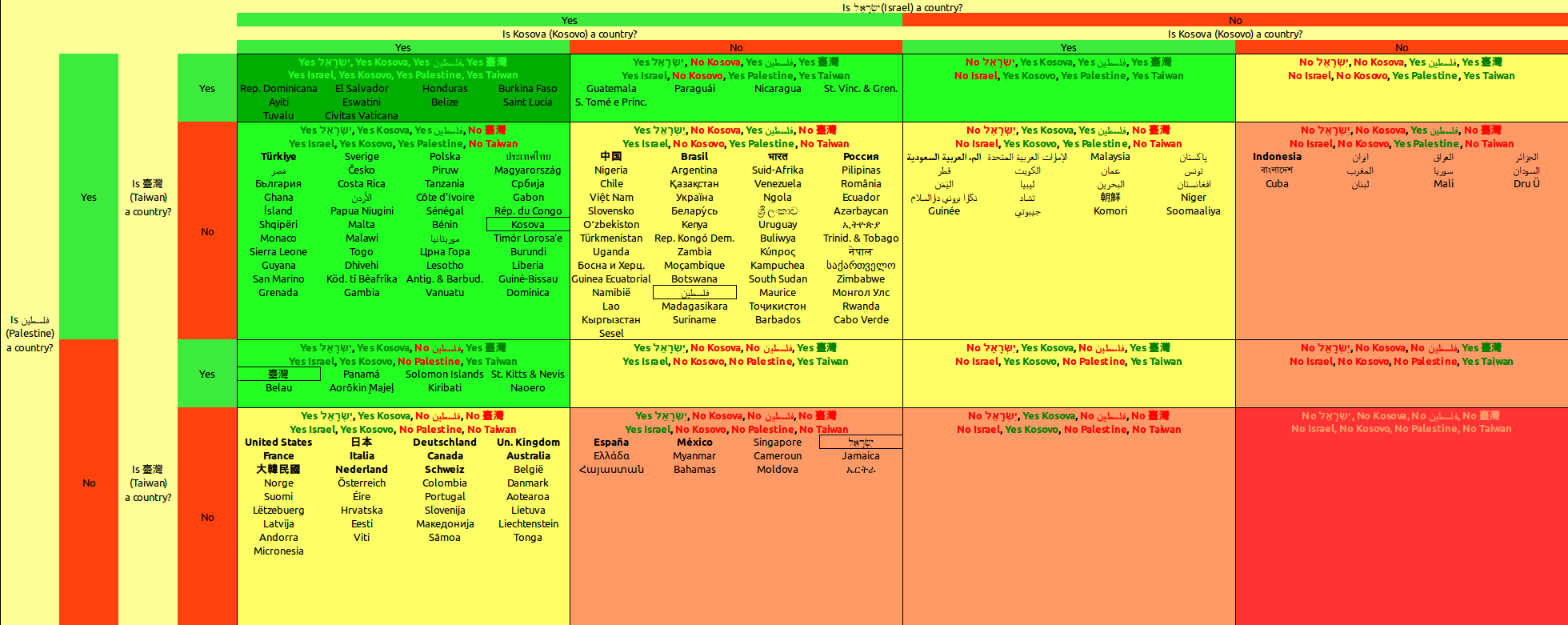
International Recognition of Israel, Kosovo, Palestine, and Taiwan

Below is a matrix categorizing the countries of the world by their stance on whether יִשְׂרָאֵל (Israel), Kosova (Kosovo), فلسطين (Palestine), and 臺灣 (Taiwan, more formally the Republic of China) are countries.

Note that all countries recognize the People’s Republic of China xor the Republic of China. All countries recognize at least one of Israel and Palestine; many recognize both.

The twenty largest economies of the world are bolded.

interrecognition

Look, El Salvador and Honduras are in the same box!

NOTE: The Ubuntu font does not properly render Hangul, Laotian, Cambodian, Dzongkha, or Dhivehi script. If it did, I would’ve incorporated them in this chart.

ERRATUM: Serbia, of course, does not actually recognize Kosovo.

Islands

Many of the Earth’s islands, shown together for height (elevation of highest point) and area comparison.

The amount of horizontal space each island takes up in the graph is proportional to the square root of the island’s area, that is, the expectation of horizontal span if one observed the island from a side.

islands